A Qualification in
Resilient Technologies
This is actively under consideration as a delivery of the Level 5 Diploma in Information Technology, Level 6 Certificates in Applied Digital Technology & Applied Software Development, and/or as a suite of micro-credentials.
A proposed one-year, studio-based programme for people who want to provide resourceful, resilient, sovereign technologies in their communities.
- Each credential is a course contributing toward the programme, or provided as a standalone micro-credential.
This qualification is about reclaiming ownership of our digital future: recovering hardware, mastering open systems, building framework-independent web solutions, and deploying lean infrastructure (physical, energy, and aerial) in places where connectivity and power cannot be assumed.
The qualification is inspired by Tairāwhiti, while being designed to serve any community where the standard technology stack is too expensive, too dependent, or simply doesn't reach.
Principles
Guided by regional realities, six ideas run through every course and shape every assessment.
-
01
Sovereignty
Every capability is framed around enabling a person, organisation, hapū or region to own its own future rather than rent it.
-
02
Open source by default
Proprietary tools are studied where useful or necessary, but the working environment is open and owned.
-
03
Durable knowledge
Fundamentals over frameworks, where students learn the layer beneath the abstraction so their skills outlast trends.
-
04
Friction as pedagogy
Nothing easy is worthwhile; nothing worthwhile is easy. The harder, more self-reliant path is where lessons are learned.
-
05
Local first
Briefs, data, clients and use cases are drawn from Tairāwhiti and comparable remote or economically-constrained regions.
-
06
AI in a supporting role
Technical assistants are allowed and taught explicitly. Assessment shifts to the learner explaining, demonstrating, and modifying work in real time.
The Studio Model
The qualification is delivered as a studio; a shared space with a tight cohort, where students are working toward the qualification or contributing for a single credential. Generous whakawhanaungatanga enables the necessarily intensive design and planning sessions, courage, and thoughtful critiques.
Each student builds their own computing base from the ground up: a reclaimed machine; a Linux environment running on both desktop and server; a lean web presence; and local AI capability. It is a connected stream of work distinctly assessed.
Each student works towards community-facing deployments for precarious scenarios: physical sensing systems; hands-on electronics and fabrication; renewable energy; and aerial operations. Building practical skills for deploying real technology in service of regional needs.
Graduate Profile
Graduates of the programme will be able to:
-
GPO 1
Advocate for sovereignty
Discuss the economic, ethical, ecological, and cultural costs of technological dependence. Recommend resilient, sovereign alternatives appropriate to remote, economically-constrained communities. Apply data sovereignty and Māori data sovereignty principles.
-
GPO 2
Own and operate open systems
Configure, customise, troubleshoot, and maintain open source computing environments; from a personal daily-driver to self-hosted servers. Apply core operating system, networking, and security principles.
-
GPO 3
Build on the open web
Build accessible, standards-based web solutions on lean foundations. Use AI assistants critically and accountably.
-
GPO 4
Deploy sovereign AI
Install and operate open source language model systems locally. Enable communities to use AI without giving up their data or paying perpetual rents to international corporations.
-
GPO 5
Build for the physical and remote
Build and deploy physical computing and sensing systems. Advocate for and setup community energy solutions; from off-grid to virtual community micro-grids. Operate aerial systems safely in dynamic and remote conditions.
-
GPO 6
Deliver for real communities
Plan and deliver a resilient technology solution to a genuine client or community brief. Justify technical, ethical, economic, and cultural choices.
-
GPO 7
Be a professional
Help shape collaborative team cultures. Communicate technical decisions clearly to known audiences. Apply critical thinking and reflective, culturally responsive practices.
Specific technologies, platforms, frameworks, and languages are not prescribed but are referred to as examples. The priority is openness, readiness, availability, and future-focused. Tools come and go, it is the underlying capability that matters.
Own your computing
Four courses and one project thread with each student building their own computing base from the ground up.
Hardware reclamation; Linux, the command line, and self-hosting foundations; a lean web presence; local AI capability. Each course assesses parts of an integrated body of work.
Establish why technological self-reliance matters for regions like Tairāwhiti, and equip students to discuss the economic, ethical, and ecological costs of dependence on global platforms. Act by reclaiming hardware and migrating to open alternatives.
What you'll learn- Discuss the economic, ethical, and ecological costs of technological dependence for a remote or economically constrained community, and recommend sovereign alternatives suited to its context.
- Audit personal and organisational digital dependencies and propose viable open, sovereign alternatives.
- Recover and reimagine end-of-life hardware to extend its useful life and reduce e-waste.
- Digital sovereignty & tino rangatiratanga
- Platform economics & lock-in
- Open source licensing
- Māori data sovereignty
- E-waste & right-to-repair
- Dependence threat modelling
- Regional capability mapping
- Digital-dependency audit and sovereign migration plan; explained and reasoned in person.
- Reimagine a discarded computer into a working, user-friendly useful state; log the process and decisions, and pitch it in person.
Develop the ability to configure, customise, and troubleshoot open source operating systems as a personal daily-driver environment, and as a self-hosted service platform. Establish the Linux skills that underpin embedded computing and the future enterprise.
What you'll learn- Configure, customise, and troubleshoot a modern Linux-based computing environment across both desktop and server roles, documented with markdown.
- Use fundamental networking concepts (TCP/IP, DNS, HTTP, SSH) to connect, access, and secure systems.
- Deploy and secure a basic self-hosted service on owned or low-cost infrastructure, applying principles of containerisation, web serving, and access control.
- Linux as daily driver & server
- Shell navigation
- Markdown documentation
- User permissions
- Processes & systemd
- Software installation models (packages, flatpaks, containers)
- Networking fundamentals (TCP/IP, DNS, HTTPS, SSH)
- Server provisioning
- Containerisation basics (e.g. Docker / Podman)
- Web server & reverse proxy (e.g. Nginx / Caddy)
- Security hardening fundamentals (firewall, fail2ban, least privilege)
- Backup & recovery
- Visual logbook; markdown portfolio maintained across the semester, capturing the evolution of a self-hosted service: configuration decisions, incidents, and iterations.
Run, integrate, and evaluate open source language models on your own infrastructure, integrating with a local knowledge base, upholding sovereignty and authority.
What you'll learn- Deploy open source language models on self-hosted infrastructure, selecting appropriate models and configurations for the available hardware.
- Integrate local models into useful knowledge bases and workflows.
- Evaluate the capabilities, limitations, costs, and ethical implications of local versus cloud AI for a defined community use case, applying data sovereignty and Māori data sovereignty principles.
- Running local LLMs (e.g. Ollama)
- Models, trade-offs & evaluations
- Serving models & local APIs
- Prompting & context management
- Retrieval-augmented generation (RAG)
- Local knowledge bases
- Data sovereignty & privacy
- Ethics with Indigenous and community knowledge
- Working local-AI application; demonstrate and critique the solving of technical tasks on own infrastructure, and querying a local knowledge base.
- Comparative evaluation; discuss local vs cloud AI for a defined brief, including capability, cost, privacy, and sovereignty trade-offs.
- Studio teach-back; teach someone else to stand up and use a local model.
Build and understand accessible, performant web solutions for the open web, using AI assistance.
What you'll learn- Build accessible, responsive, performant websites using modern HTML and CSS and JavaScript, static site generator foundations, and no lock-in.
- Use AI coding assistants while understanding the code they produce.
- The browser
- Design principles
- Semantic HTML
- CSS grid & flexbox
- Custom properties & intrinsic design
- Vanilla JavaScript & the DOM
- Accessibility (WCAG)
- Static site generation (e.g. Eleventy)
- Performance & optimisation
- AI-assisted development
- Build project; a real portfolio site deployed on student-owned hosting, with design and development decisions demonstrated and rationalised in person.
- Code walkthrough; explain and modify your codebase.
- Performance & accessibility audit of a peer's site.
Serve your region
Four courses and one project thread focused on community deployments in constrained conditions.
Physical sensing systems; digital fabrication; fundamental electronics skills; lean renewable energy; aerial operations. Each course assesses parts of an integrated body of work.
Build small, low-cost computing and sensing devices that capture and act on real-world data for practical local applications; connect them back to own infrastructure.
What you'll learn- Assemble and program single-board computers and microcontrollers to interface with sensors and actuators for a defined local use case.
- Capture, store and present real-world sensor data, transmitting it to a self-hosted endpoint and making it usable for a community purpose.
- Select and implement appropriate communication protocols to move data reliably from embedded devices to self-hosted infrastructure.
- Single-board computers (e.g. Raspberry Pi)
- Microcontrollers (e.g. ESP32)
- GPIO, sensors & actuators
- Python
- Data capture, storage & visualisation
- On-device protocols (I2C, SPI, UART)
- Network messaging (MQTT, HTTP)
- Field deployment, automation & reliability (systemd services, watchdogs)
- Low-power design & sleep modes
- Ethics of sensing & consent
- Working sensing device; demonstrated in real conditions, with a record of decisions and iterations.
- Deployed data-capture mini-project; a sensing solution for a defined local problem, presented to the cohort with live data, taking follow-up questions.
Develop hands-on electronics and making skills to build, house, and repair physical technology systems.
What you'll learn- Apply electronics fundamentals to assemble, test, and repair circuits; reading schematics, selecting components, soldering, and diagnosing faults with appropriate tools.
- Design and fabricate physical enclosures, mounts, and structural elements using digital fabrication tools suited to real field conditions.
- Basic components: resistors, capacitors, diodes, transistors
- Reading schematics & datasheets
- Breadboarding & prototyping
- Soldering (through-hole & basic SMD)
- Multimeter & diagnostic tools
- Power: voltage, current, regulators & protection
- 3D printing (FDM)
- CAD for fabrication (e.g. FreeCAD, OpenSCAD)
- Laser cutting
- Weatherproofing, cable management & connectors
- Electronics build; assemble and test a circuit from a schematic, demonstrating soldering technique and fault diagnosis.
- Fabrication project; design and fabricate a field-ready housing or mount for a physical computing device, with documented design decisions and iterations.
Specify, size, and evaluate community energy systems, from off-grid solar and wind to grid-connected micro-grids; covering generation, storage, grid interface, and the models that make community ownership of power achievable.
What you'll learn- Specify and size a community energy system, including generation (solar, wind) and storage, for a defined application, demonstrating understanding of site assessment, component selection, DC/AC system design and battery management.
- Evaluate off-grid, grid-tied and virtual community micro-grid configurations for their technical, economic and sovereignty implications in a given community context.
- Use energy monitoring tools to measure, visualise and interpret system performance, and communicate findings and recommendations to a non-technical community audience.
- Solar panels
- Small wind generation
- DC systems, charge controllers & MPPT
- Inverters for off-grid, grid-tied & hybrid
- Battery technologies & management
- System siting, sizing & load
- Grid-tied systems & net metering
- Community micro-grids: physical & virtual
- Energy monitoring & dashboards
- Resilience, backup & economic analysis
- Energy system design; size and specify an off-grid or hybrid solar system for a defined regional community or residential building, deploy if available.
- Community energy proposal; instrument and analyse a real energy profile, then produce a micro-grid proposal for a remote scenario, covering economics and ownership.
Develop safe, lawful drone operations; from manual flight to autonomous mission planning and aerial data processing in service of real, remote community needs.
What you'll learn- Operate UAVs safely and lawfully under CAA Part 101 with pre-flight, flight, and post-flight practice.
- Capture, process, and assess aerial data-capture from a planned mission, using appropriate tools and sensor payloads.
- Apply appropriate consent, privacy, and data sovereignty practices to aerial observation.
- UAV types, manual and autonomous flight
- CAA Part 101 & 102, airspace and safety management
- Mission and site planning
- Sensor payloads (RGB, multispectral, thermal)
- Photogrammetry and mapping outputs
- Community applications
- Privacy, consent and data sovereignty
- Flight competency; complete pre-flight, flight, and post-flight procedures for a defined task, meeting CAA Part 101 requirements, with a documented flight record.
- Mission & data project; plan, fly, and process a mapping or sensing mission for a real regional brief, with consideration for consent and data sovereignty.
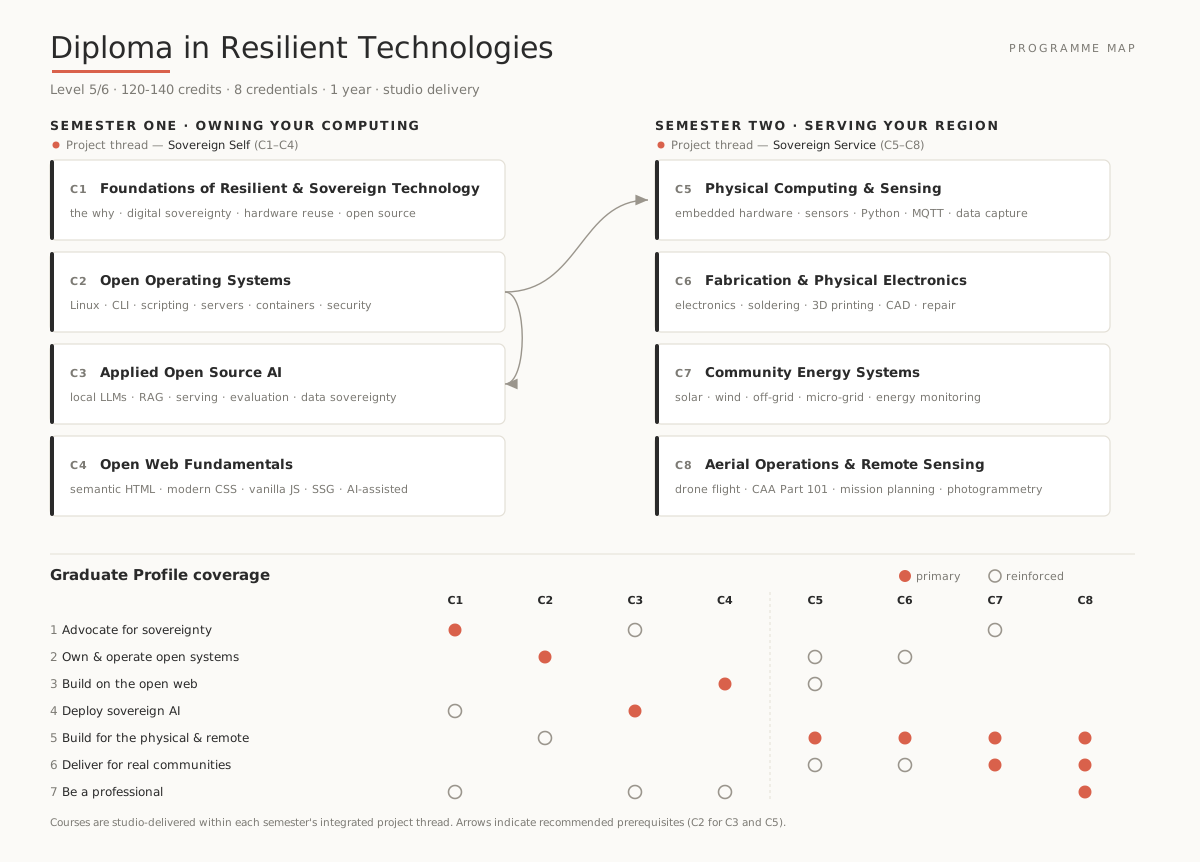
Programme Map
Course sequence, prerequisite flow, and graduate profile coverage at a glance.